Download Ebook Minimum Wages (MIT Press), by David Neumark, William L. Wascher
The Minimum Wages (MIT Press), By David Neumark, William L. Wascher tends to be terrific reading book that is easy to understand. This is why this book Minimum Wages (MIT Press), By David Neumark, William L. Wascher comes to be a favored book to check out. Why don't you desire turned into one of them? You could appreciate reviewing Minimum Wages (MIT Press), By David Neumark, William L. Wascher while doing other tasks. The existence of the soft file of this book Minimum Wages (MIT Press), By David Neumark, William L. Wascher is type of getting encounter effortlessly. It includes how you need to save the book Minimum Wages (MIT Press), By David Neumark, William L. Wascher, not in shelves of course. You may save it in your computer system gadget and device.
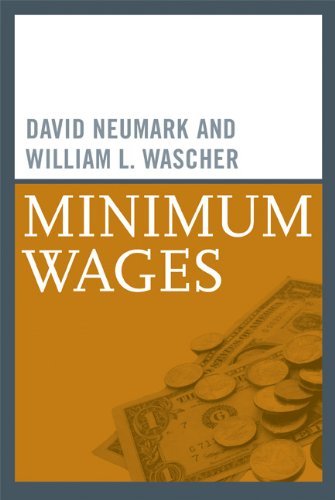
Minimum Wages (MIT Press), by David Neumark, William L. Wascher

Download Ebook Minimum Wages (MIT Press), by David Neumark, William L. Wascher
Idea in selecting the very best book Minimum Wages (MIT Press), By David Neumark, William L. Wascher to read this day can be obtained by reading this resource. You can discover the most effective book Minimum Wages (MIT Press), By David Neumark, William L. Wascher that is marketed in this globe. Not just had the books published from this country, yet also the various other countries. And now, we suppose you to check out Minimum Wages (MIT Press), By David Neumark, William L. Wascher as one of the reading materials. This is just one of the very best books to collect in this website. Consider the resource and also browse the books Minimum Wages (MIT Press), By David Neumark, William L. Wascher You could find lots of titles of the books supplied.
This is why we advise you to always visit this web page when you need such book Minimum Wages (MIT Press), By David Neumark, William L. Wascher, every book. By online, you may not go to get guide establishment in your city. By this on-line library, you could find guide that you really intend to check out after for very long time. This Minimum Wages (MIT Press), By David Neumark, William L. Wascher, as one of the recommended readings, has the tendency to be in soft data, as every one of book collections right here. So, you might additionally not get ready for couple of days later on to get as well as read the book Minimum Wages (MIT Press), By David Neumark, William L. Wascher.
The soft documents suggests that you have to visit the web link for downloading and install and after that save Minimum Wages (MIT Press), By David Neumark, William L. Wascher You have actually possessed guide to check out, you have actually positioned this Minimum Wages (MIT Press), By David Neumark, William L. Wascher It is not difficult as visiting guide shops, is it? After getting this brief explanation, hopefully you can download and install one and also start to read Minimum Wages (MIT Press), By David Neumark, William L. Wascher This book is extremely simple to check out every single time you have the leisure time.
It's no any kind of faults when others with their phone on their hand, as well as you're also. The distinction may last on the product to open up Minimum Wages (MIT Press), By David Neumark, William L. Wascher When others open up the phone for chatting and speaking all points, you can in some cases open up and also check out the soft data of the Minimum Wages (MIT Press), By David Neumark, William L. Wascher Obviously, it's unless your phone is available. You could also make or wait in your laptop or computer system that eases you to check out Minimum Wages (MIT Press), By David Neumark, William L. Wascher.
Minimum wages exist in more than one hundred countries, both industrialized and developing. The United States passed a federal minimum wage law in 1938 and has increased the minimum wage and its coverage at irregular intervals ever since; in addition, as of the beginning of 2008, thirty-two states and the District of Columbia had established a minimum wage higher than the federal level, and numerous other local jurisdictions had in place "living wage" laws. Over the years, the minimum wage has been popular with the public, controversial in the political arena, and the subject of vigorous debate among economists over its costs and benefits. In this book, David Neumark and William Wascher offer a comprehensive overview of the evidence on the economic effects of minimum wages. Synthesizing nearly two decades of their own research and reviewing other research that touches on the same questions, Neumark and Wascher discuss the effects of minimum wages on employment and hours, the acquisition of skills, the wage and income distributions, longer-term labor market outcomes, prices, and the aggregate economy. Arguing that the usual focus on employment effects is too limiting, they present a broader, empirically based inquiry that will better inform policymakers about the costs and benefits of the minimum wage. Based on their comprehensive reading of the evidence, Neumark and Wascher argue that minimum wages do not achieve the main goals set forth by their supporters. They reduce employment opportunities for less-skilled workers and tend to reduce their earnings; they are not an effective means of reducing poverty; and they appear to have adverse longer-term effects on wages and earnings, in part by reducing the acquisition of human capital. The authors argue that policymakers should instead look for other tools to raise the wages of low-skill workers and to provide poor families with an acceptable standard of living.
- Sales Rank: #805724 in eBooks
- Published on: 2010-08-13
- Released on: 2010-08-13
- Format: Kindle eBook
Review
Beyond covering previously sparse treatments of issues such as effects on prices, inflation, profits, and inequality, Neumark and Wascher demonstrate the overwhelming weight and detrimental effects of minimum wages on low-skilled workers. The volume is a must for anyone interested in research on labor markets.
(Daniel Hamermesh, Centennial Professor of Economics, University of Texas at Austin)
Over the past 20 years, the focus of research on the minimum wage has changed from federal to state minimum wages as the key policy variable, and from effects on teen employment to a broader range of outcomes. David Neumark and William Wascher have been important contributors to these innovations. Minimum Wages combines a very accessible summary of their research with helpful discussions of others' work.
(Charles Brown, Professor of Economics, University of Michigan)
This is a superb book, notable for both breadth and depth of coverage, on one of the most fundamental topics in economics...Summing Up: Essential. Economics collections, upper-division undergraduate through professional.
(Choice)
About the Author
William L. Wascher is Senior Associate Director in the Division of Research and Statistics at the Federal Reserve Board.
Most helpful customer reviews
3 of 3 people found the following review helpful.
Excellent Analysis of the Impact of the Minimum Wage
By John R. Holmes, Jr.
This excellent book surveys virtually all of the published research on the minimum wage since1938. Parts of it will be pretty heavy sledding for those of us not trained in econometrics, because it’s littered with mathematical formulas that not one person in a thousand could understand. However, the authors do a good job of explaining their science, methodologies and conclusions in words as well. A listing of the chapters shows the questions being addressed:
1 Introduction.
2 The History of the Minimum Wage in the United States.
3 The Effects of Minimum Wages on Employment.
4 Minimum Wage Effects on the Distribution of Wages and Earnings.
5 The Effects of Minimum Wages on the Distribution of Incomes.
6 The Effects of Minimum Wages on Skills.
7 The Effects of Minimum Wages on Prices and Profits.
8 The Political Economy of Minimum Wages.
9 Summary and Conclusions.
The most obvious question is, if we don’t like the authors’ conclusions, why should we believe them? Well, it seems that the impact of Minimum Wages has been heavily studied since its inception, and while the authors describe their own research, they also rigorously present the research and conclusions of others. In fact, the extensive coverage of existing literature is one of the reasons this book is challenging. The list of references alone is about 24 pages with over 400 separate citations.
Another obvious question is whether it’s even possible to figure out the effects of a change in the minimum wage. After all, many things affect the labor market, so how can we isolate out the effects of a change in just one variable? For example, in July 2007, just as the U.S. economy was beginning to tank, the federal minimum wage was increased 13.6% from $5.15 to $5.85. Then, when the economy was clearly in free fall and unemployment skyrocketing a year later, the minimum wage was increased another 12% to $6.55. So can we say that a compounded 27% increase in the minimum wage within a one-year period caused the second-biggest economic crisis in U.S. history? No, nobody thinks that.
Fortunately for these analysts, not only has the federal minimum wage changed numerous times over the last 75 years, but most of the states have implemented widely varying minimum wages that have changed even more frequently. As a result, econometricians have access to sufficient data to distill out the effects of the minimum wage against the background of countless unrelated changes in the national and regional economies. Moreover, the granularity of the data by region, demographics, and wage levels is astonishing. I’ll leave it to the authors to persuade you of their science, but I came away persuaded.
As for the conclusion (insert spoiler alert here) it seems that the minimum wage achieves virtually none of the goals advanced by its proponents. In fact, in many cases it hurts the very populations it is intended to help. The authors do a good job of explaining the linkage between their studies, their data, and their conclusions, so I won’t attempt to repeat it here, except to mention one of the causalities that wouldn’t be obvious someone that stopped with Economics 101.
It goes like this: The iron law of neoclassical economics is supply and demand. If you raise the price of something, the demand is assumed to fall. And because of this, even the most ardent proponent of raising the minimum wage would have to sense that he’s feeding into the forces of automation and outsourcing when he wants to raise the price of labor. But it turns out reduced aggregate demand isn’t the most significant problem. Quite to the contrary, it seems that raising the price of the lowest tier of the labor pool causes a shift in demand, not up but down – to even more expensive workers. The authors call this phenomenon “spillover,” which I’ll try to explain.
To understand spillover (shifting of demand to higher-priced items), we have to recognize that prices force shoppers to choose. All economic goods can be rank ordered, but knowing which is the “best” isn’t a good predictor of what’s going to sell. For easy example, if you look for men’s watches on Amazon, you’ll find an assortment of popular brands, including Timex, Casio, Seiko, Citizen and Tag Heuer. Currently, Tag Heuer lists for about 50-times the price of Timex, and we don’t have to know anything about watches to know that, confronted with such vast price differentials, some will choose Tag Heuer, but more will settle for one of the less expensive brands.
Labor is subject to the same market forces. It’s not just manufactured goods – everything with a price goes through this filter. My local market sells regular tomatoes for around $2.49/lb and “organic” tomatoes for $3.49/lb. Without the little sticker you couldn’t tell them apart, but somebody obviously thinks there’s a difference because people are willing to pay 40% more for organic. What’s less obvious is that the market rank orders two human beings the way it orders watches and tomatoes – by price. And the reason “cheaper” labor gets selected is because, even though employers may perceive one worker as less productive than another, the less productive ones are also less expensive.
Enter price controls and resulting spillover. What happens to Timex if you legislate a “Minimum Watch Price?” What happens to regular tomatoes if you establish a “Minimum Tomato Price?” Now everything is more expensive, but if it’s true that purchasers only choose the lesser good because it’s cheaper, then as the price gap narrows, the benefit of choosing cheaper diminishes. Suddenly, what was an unreachable distance up the price curve is now much closer, albeit only because the bottom of the curve has been legislatively raised and all goods are more expensive.
A shallow view of supply and demand imagines that the response to rising prices is not to consume. But in the case of business that require significant human labor, this generally not an option. What is an option, however, is to take advantage of the narrowing price gap between lower-skilled and higher skilled labor to spend more to get more – and this is exactly what the data show. When the minimum wage rises, the low-skilled population loses work hours as employers utilize higher-skilled workers that now are more cost effective. But because it’s a “spillover” between labor categories, the aggregate employment data don’t show the decline that would tip off Minimum Wage proponents that their strategies are not having the desired outcome.
In summary, this book will open your eyes to non-obvious issues surrounding the Minimum Wage. Most of the conclusions run counter to our intuitions, so for some it will be hard to swallow. Basically, increases in the Minimum Wage end up being generally harmful to the populations they’re intended to benefit, and as the authors point out, there are better alternatives. One of them, the Earned Income Tax Credit apparently does a much better job of targeting those in need (despite some well published failures of IRS monitoring). So if you’re interested in the plight of the poor and want to understand the options, this is an excellent place to start.
1 of 1 people found the following review helpful.
Accessible to laypersons
By Christopher W. Robertson
I am pleased with this book. It is accessible to the informed layperson and is not heavy on jargon or formulas.
0 of 1 people found the following review helpful.
The Authority
By SueDonym
The minimum wage is a controversial topic politically and within the academic community. We'd all like to help people in poverty but there are unintended consequences from a minimum wage that could hurt rather than help them. Neumark is the authority.
See all 9 customer reviews...
Minimum Wages (MIT Press), by David Neumark, William L. Wascher PDF
Minimum Wages (MIT Press), by David Neumark, William L. Wascher EPub
Minimum Wages (MIT Press), by David Neumark, William L. Wascher Doc
Minimum Wages (MIT Press), by David Neumark, William L. Wascher iBooks
Minimum Wages (MIT Press), by David Neumark, William L. Wascher rtf
Minimum Wages (MIT Press), by David Neumark, William L. Wascher Mobipocket
Minimum Wages (MIT Press), by David Neumark, William L. Wascher Kindle
Minimum Wages (MIT Press), by David Neumark, William L. Wascher PDF
Minimum Wages (MIT Press), by David Neumark, William L. Wascher PDF
Minimum Wages (MIT Press), by David Neumark, William L. Wascher PDF
Minimum Wages (MIT Press), by David Neumark, William L. Wascher PDF


